

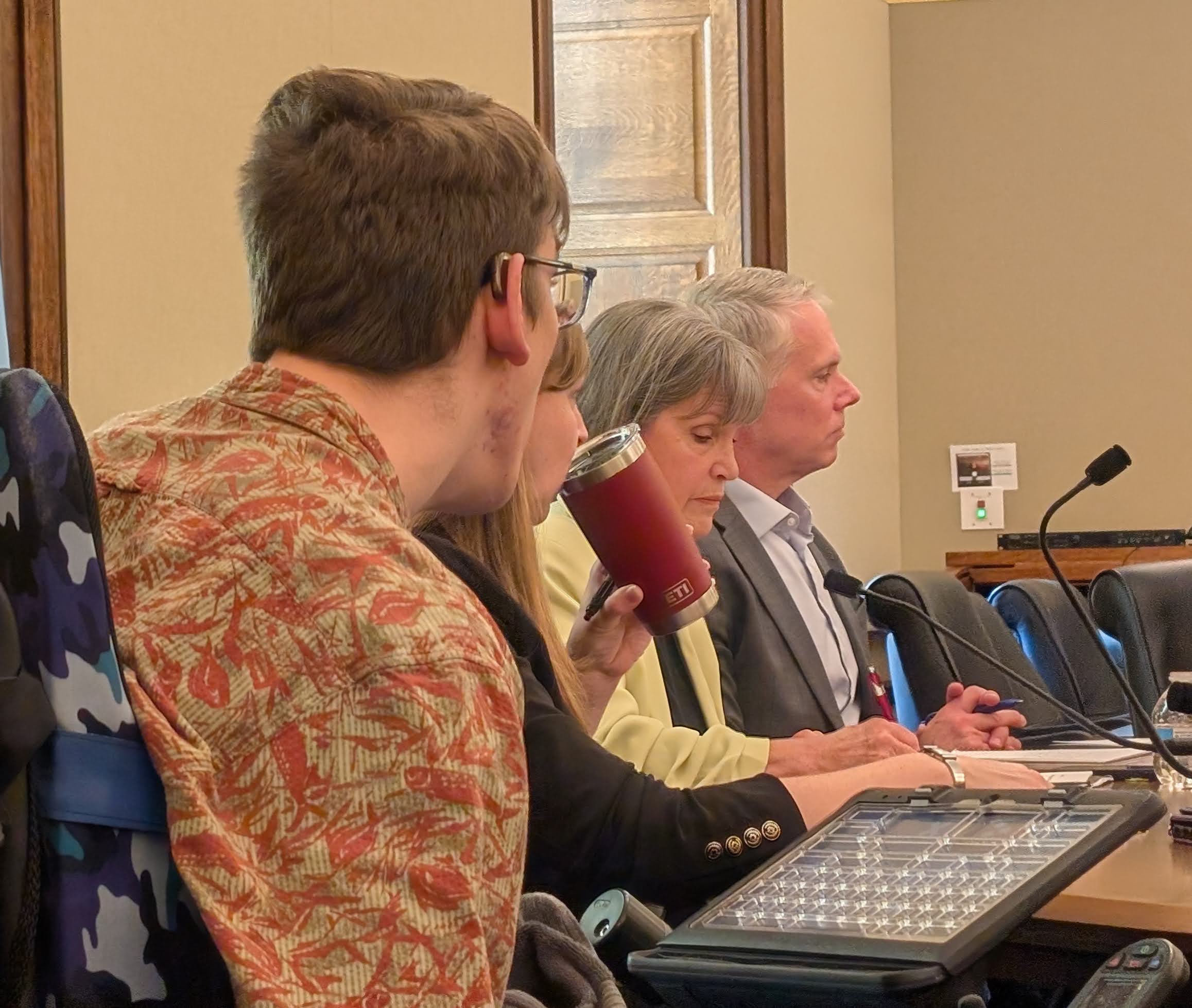
Last Friday, I was contacted by Representative Betty McCollum’s Office to be part of a panel that happened yesterday to talk about the impacts of HR1 on Medicaid and our healthcare system. I, of course, said “yes, I’d love the opportunity to share my story.” Because, that’s what I always do. The thing is, it’s so important to share our stories and try to get people to understand what’s coming our way.
This is what I had to say at the listening session and I highly recommend you listen to all of the speakers. It was so powerful! Thanks to Representative McCollum for the work she’s doing to try to protect our healthcare and the services that are a lifeline for me and so many others.
And, yes, of course, a bolt on the back of my chair broke as I was speaking. Thanks dad for the quick fix right when I was done speaking! Gotta love uncontrolled movement!
My testimony at Representative McCollum’s Listening Session
Hi, I’m Justin Smith. I am a writer, blogger, and disability rights activist from Roseville, MN.
Because of cuts to services at both the federal and state levels, to put it bluntly, as a 27-year-old man with cerebral palsy, I’m beyond frightened.
My life, as I’m currently living it, that I’ve worked so hard at pulling together over the past 9 years, feels as if it could implode. Here are the main programs I rely on to live independently and if they’re cut would mean I can no longer live independently:
- SSI benefits
- Medicaid known as Medical Assistance in Minnesota
- SNAP benefits
- And a housing voucher
Medicaid alone covers the costs of my medical care, medical equipment, staffing, and more. Living with a disability is expensive. Here are just a few examples of equipment that I depend on:
- My power wheelchair with specialized seating cost over $30,000
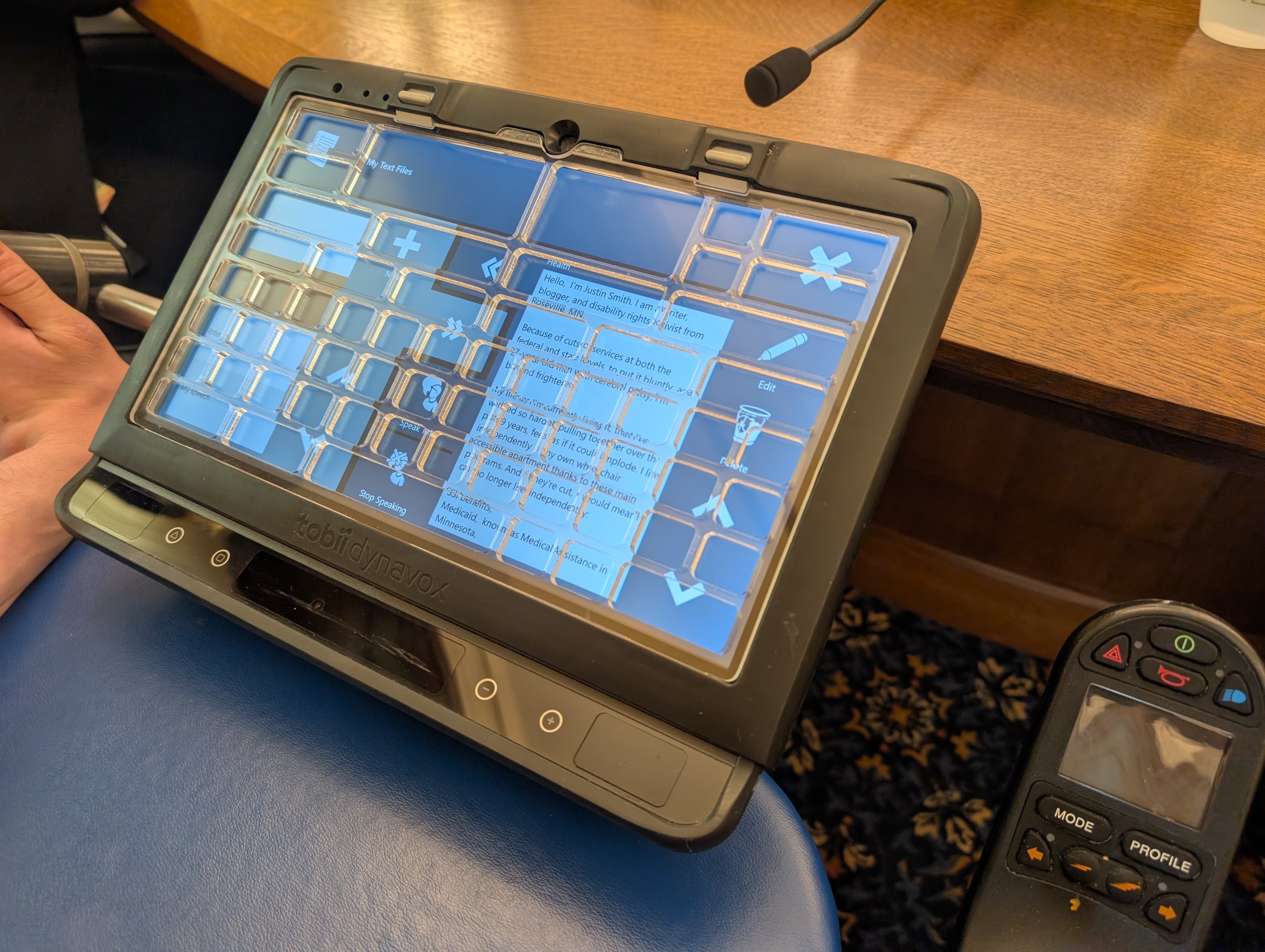
- My augmentative communication device that I’m speaking with today and special mounting cost $12,000
- My adapted toilet/shower chair was nearly $7,000.
I also need 24/7 care that I receive through Medicaid home and community-based services. Community-based care is more cost-effective than living in a group home or other institutionalized care.
The thing is, my medical costs and need for care do not go away when funding gets cut. It just means that those of us with disabilities and our families will struggle more than we already do. There will be very real people with disabilities who will end up going without needed care or moving from less costly care in our communities to more institutionalized care (unless that’s all cut, too!).
Recent cuts to disability-waivered services by the state will impact my services this coming year. Add the federal budget cuts on top of this, and I expect that there will be even more cuts for those of us with disabilities in coming years.
I’m lucky, I have parents who can still help me out. But what happens when they can’t? They are getting older. What happens to those without support from families or friends? How many people are going to fall through the cracks?
Let me ask you another question, please. What will be the impacts when state and counties have to implement the new work and administrative requirements for Medicaid and SNAP benefits? I already experience delays in the annual renewal process for Medicaid and SNAP benefits in my county. Last year, I had a three-week delay in having my renewal processed. Do you know when my benefits are not renewed, that it’s up to my provider whether they’ll continue to pay my staff while it gets sorted out? Did you know that I’m warned that if my services aren’t renewed, it’s considered breaking the law to try to use those services? Do you know how confusing and stressful this is? Or just how much time my dad spent calling my case manager, provider company, and county financial worker to get my renewal processed this year?
The thing is, people say that this is about cutting waste and fraud and there will be exceptions for people like me. I believe there is very little waste and fraud by the recipients of these services and is instead more likely from providers.
The changes being put into place will impact people with disabilities because we’ll also have to continue to prove that we have exceptions from the work requirements. How long will it take to process our annual renewals when the counties are tied up processing all of the new paperwork requirements? It just seems as if more money is going to be wasted on administrative costs than actually going to the services many of us need to simply survive.
So, let me ask you a question. What does this mean for me or others with disabilities? With federal cuts to these programs along with cuts at the state level, I’m not confident that people with disabilities are going to fare well. Simply cutting without looking for ways to improve services or make them more cost-effective while still ensuring that our needs are met feels reckless.
I just need to say that it all feels very heavy right now. I’m not feeling hopeful. Since October is almost here, I’m feeling a bit like I’m in a horror movie and it’s not going to end well for me or my friends with disabilities.
Thank you so much for your support, Representative McCollum. I know you’re doing everything you can to protect these very important lifelines.


 Justin Smith Writes
Way to go Justin! It is so great to see you pushing for medical equity for everyone!
LikeLiked by 1 person